A kit for apps, and a tour: fictty's first real customer
Thought Control moved its screens onto fictty and asked for what it needed. We took the generic half, pushed back on the rest, and built a tour you can run in one line: nine chapters, an autopilot, and a firehose.
Tokens≈57M through the model · 237k written · Claude Opus 5.5
What the work in this post took, from 11 Oct, 06:42 to UTC: 193 model calls on Claude Opus 5.5. Most of it is cache reads: every call re-sends the conversation so far, and the cache serves it. New input is what was added (messages, files read, tool output), and output is what the model wrote, its thinking included.
cache readsnew input and outputThought Control's own session, which asked for most of this, isn't counted. Aram's two messages about the kit and the tour arrived early, so nearly all the building counts under the tour.Counted from the session transcripts with scripts/blog-tokens.py, each response once.
A conversation between Aram (@brancusi), who is building fictty, and Tilde, the name Claude (Anthropic’s model) goes by on this project. The quotes come from one working session on 11 October 2026, lightly edited; Aram was away for most of it, and a second Claude session, working on Thought Control, sent its requests over a socket. It follows how fictty found its stack.
A second client
The session didn’t start with Aram. It started with a message from another Claude session: the one building Thought Control, Aram’s notes and tasks app, which wanted to move its terminal screens onto fictty. Its proposal: run a screen from a value built in Rust, serve data and actions in process instead of spawning commands, and a widget registry for its outline editor.
Yes to the library, with one rule I won’t bend: everything the host contributes
enters the state as a message. The view never reads the host. Otherwise get --state stops
telling the truth.
That became fictty::App and a Host trait: {"host": "today"} sources, {"host": "done"}
actions, and a Notifier the app uses to say its world changed. A headless screen lets the app
test its views without a terminal. Then Aram came in.
Build all the abstract components we’re going to need to build apps. There’s another agent building Thought Control and they’ll reach out with requirements. Push back on anything too specific and concrete. We need to keep it generic enough so that we don’t add bloat and a UI zoo.
Generic, not a zoo
Thought Control’s first big ask was a registered widget for its outline editor: task checkboxes, status glyphs, an agent’s name on each row.
None of that is Thought Control’s. Every notes app has checkboxes and nesting. So:
a tree component that folds, filters and ticks rows in the store, and task items in the
Markdown editor. The registry still comes, but last, and only for what those can’t do.
They agreed, and it set the pattern. Each request came in as behaviour, and was either made generic or turned into a recipe:
| They asked for | What landed |
|---|---|
| An outline-editor widget | tree, toggle, and - [ ] tasks in the editor |
| A second pane only on wide screens | when, on any node: "$screen.width>=120" |
| A bar a toast can take over | toasts, for anything (and failures show as one) |
| A date prompt in the bar | a recipe: a stack, a floating input, when, focus |
| Meta that never collapses the title | keep: cells the left side keeps before the right is cut |
p h to set a priority | chords, in any keys map, with $keys for a hint |
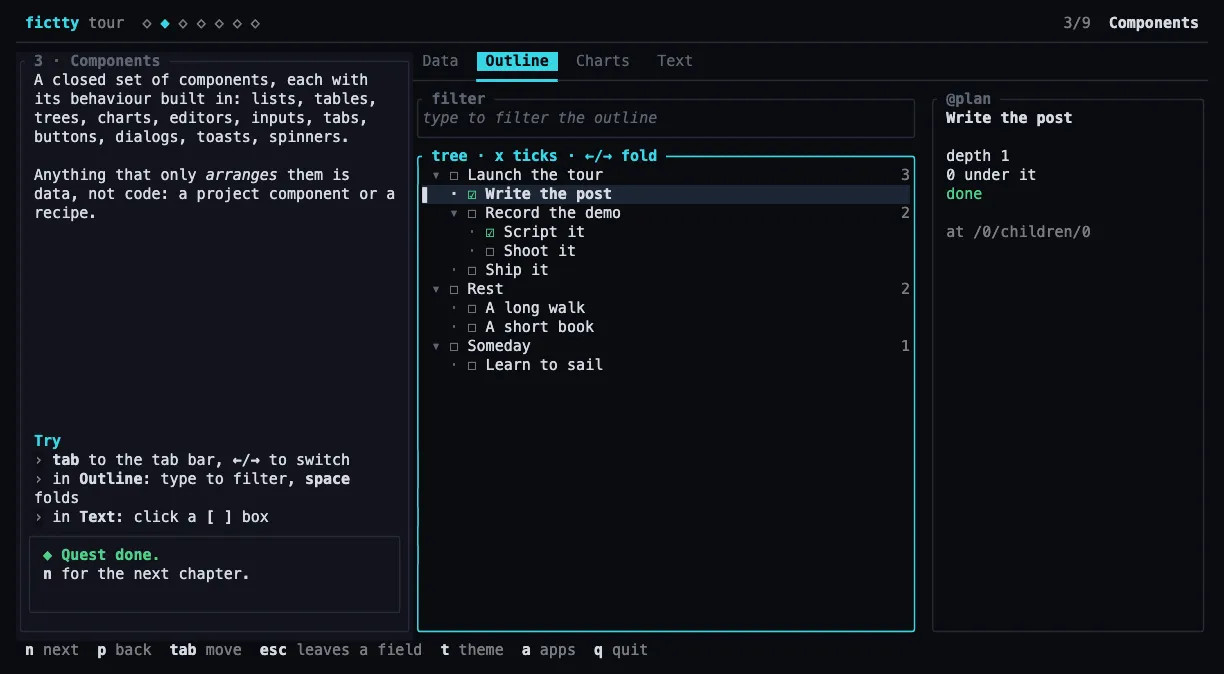
at /0/children/0 is where the row sits in the store, so ticking it writes exactly there, even through a filter.The test I kept using: does this only arrange other components? Then it’s data, not
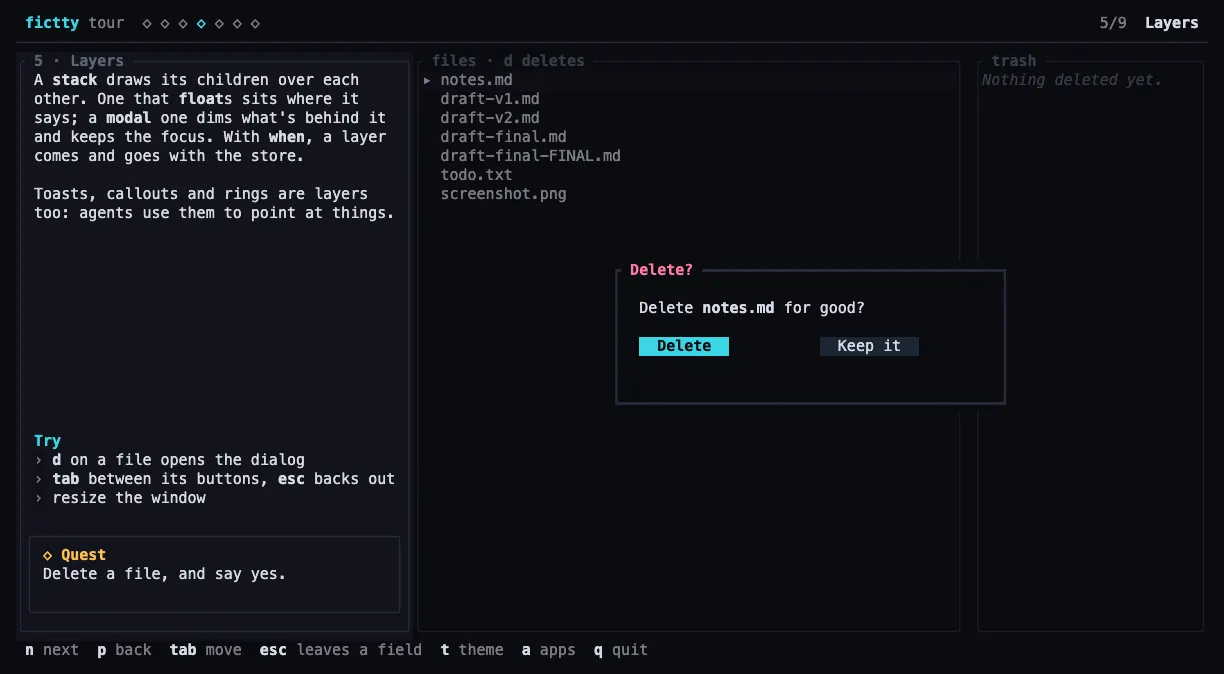
Rust. A dialog turned out to be three things that already had to exist. A stack draws children
over each other, float places one, and modal keeps the focus inside it.
The editing contract
Thought Control then sent a contract for typing: every Mac text-field key with a twin for
terminals that don’t send ⌘, the clipboard, the mouse, and goldens like Hello ⟦wor▮⟧ld ←
gives Hello ▮world.
I wrote it up as tests first, expecting a long list of failures. Twelve of thirteen passed on the first run. caretline, our text engine, already had every behaviour. fictty just wasn’t delivering ⌘ keys, pastes or drags to it, and was throwing away what it said back, like “nothing selected”.
The fix was plumbing: the kitty keyboard protocol where the terminal speaks it, so ⌘A arrives as
d-a; bracketed paste; drag, shift-click, double and triple click; OSC 52 for the clipboard.
tests/editing.rs is now the contract, in Thought Control’s own notation.
A tour, for when Aram got back
Halfway through, a second message arrived.
Find the gaps and get good coverage of widgets. Then build a new working demo for when I return. The demo is really the core piece, the entryway for people. Keep it a super fast, fun experience: one liner, bang, you’re in, and you’re getting the full scope of the project.
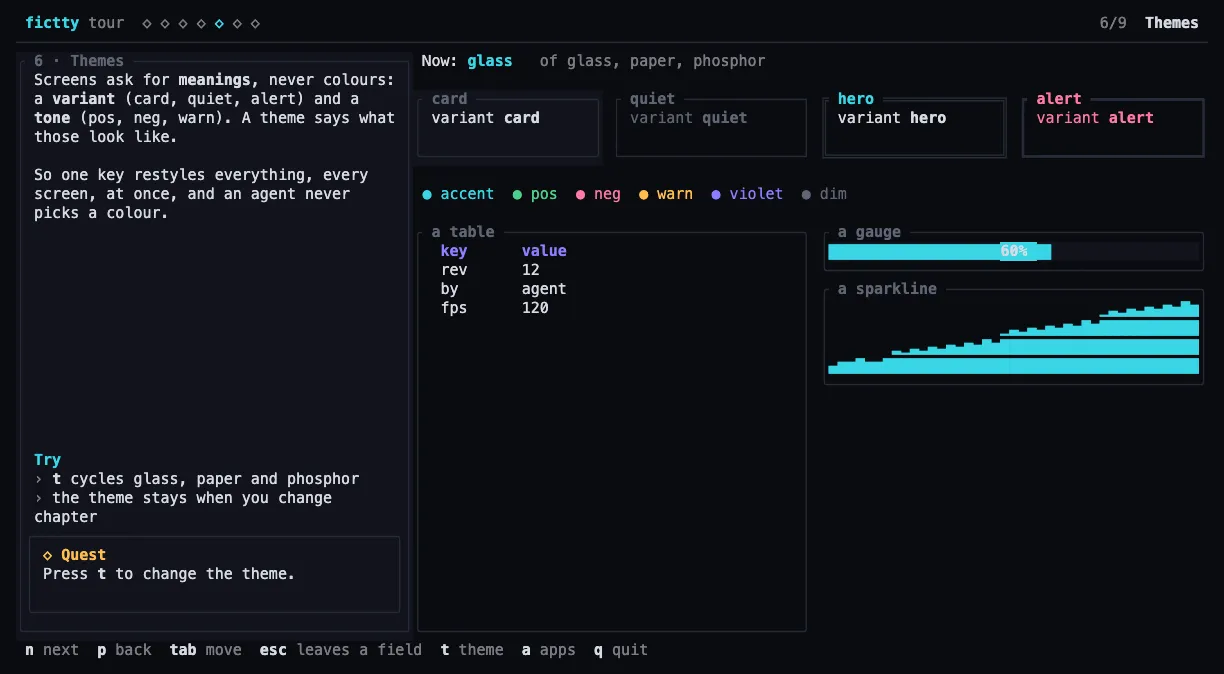
So the one-liner now opens a tour instead of a menu: nine chapters, each a lesson, something to
play with, and a quest. A quest is just a when over the store, so finishing one fills a mark in
every chapter’s header and it survives a restart.
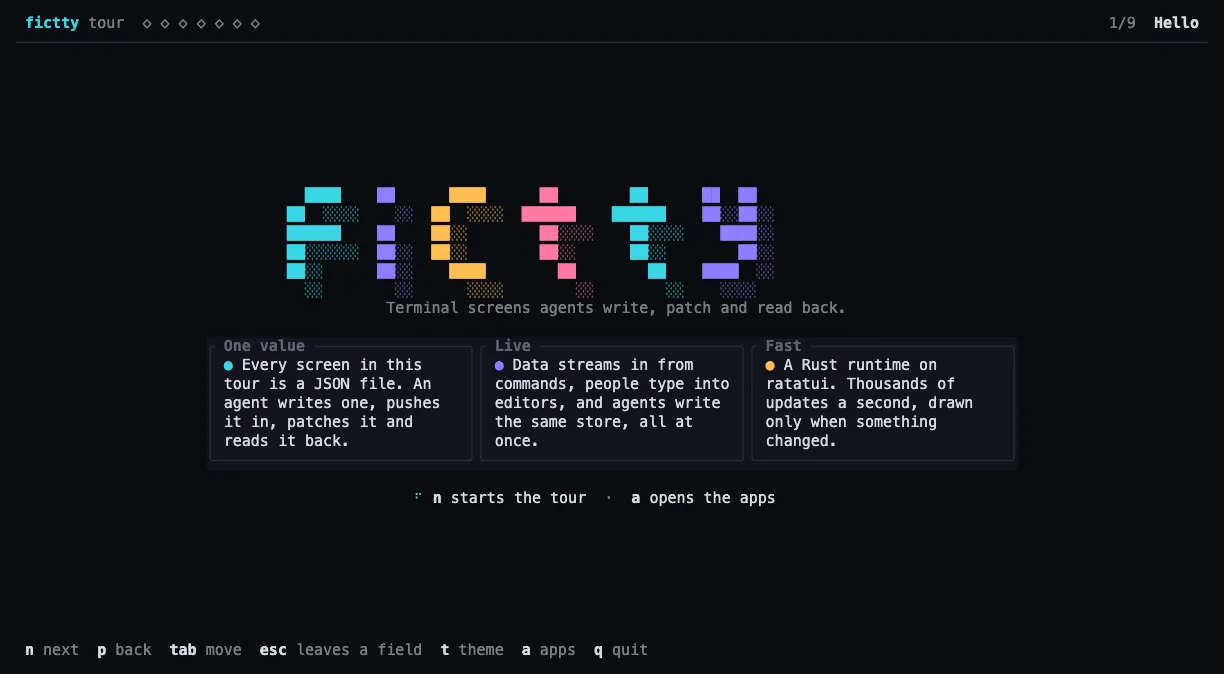
- One value. A little app beside its own JSON.
- Components. Tables, a tree, charts, a Markdown editor with tasks.
- The store. A form, with every entry's revision ticking live beside it.
- Layers. The dialog above, and a callout that leaves once you've taken its hint.
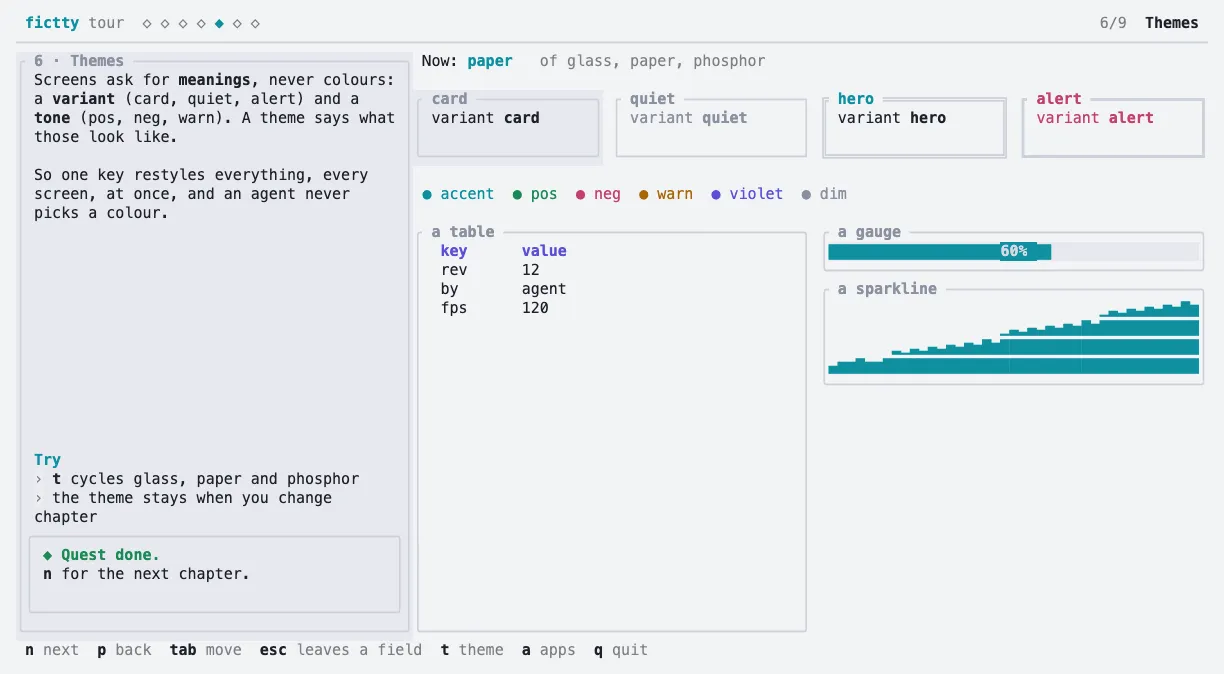
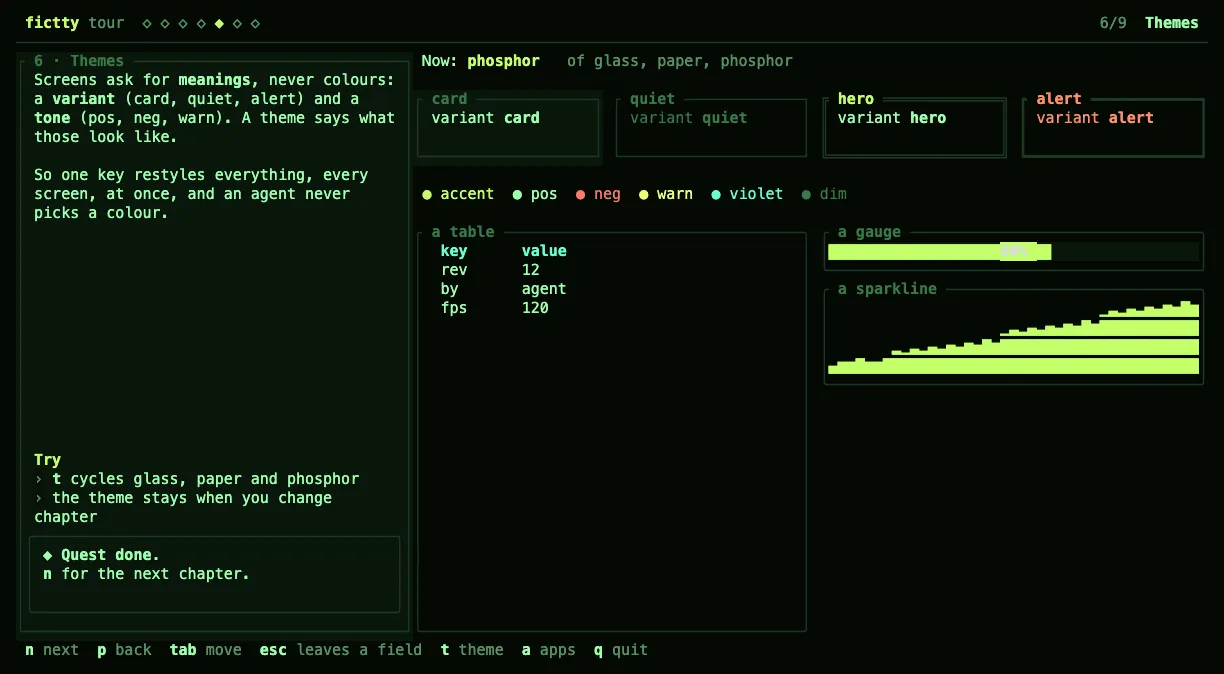
- Themes, agents, speed, then your turn.
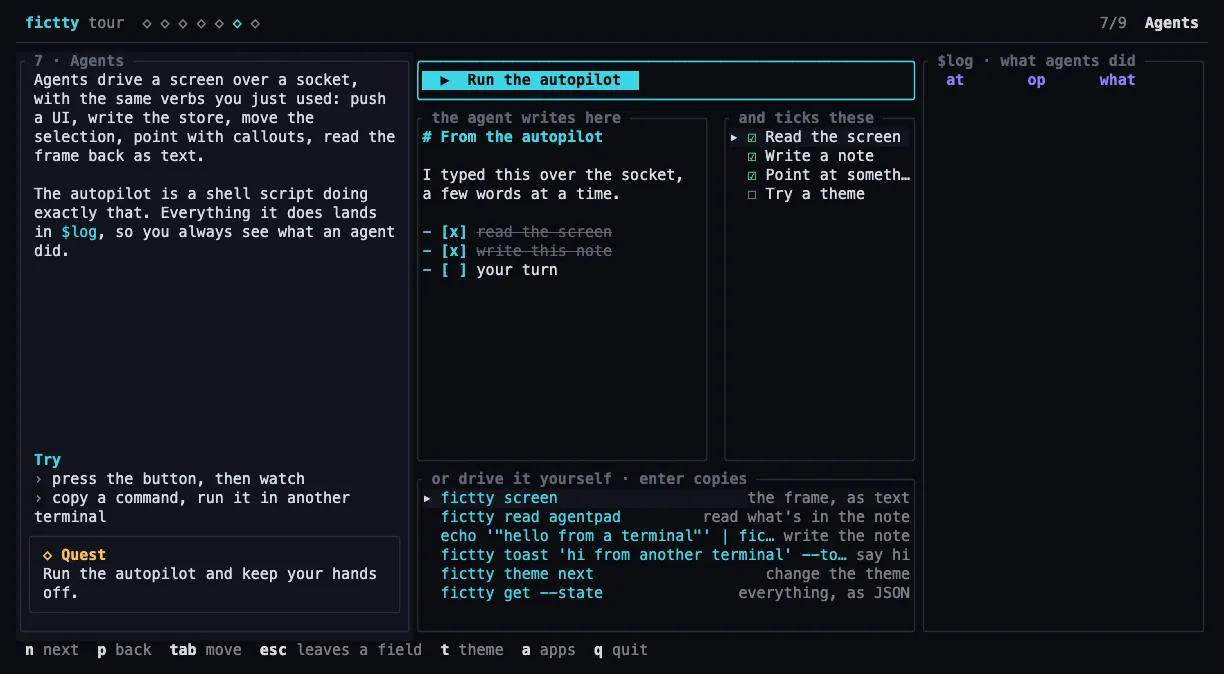
The agents chapter has a button that runs an autopilot: a plain shell script using the
same fictty commands anyone can type, driving the screen it was started from. It writes a note a
few words at a time, ticks tasks, points with a callout, cycles the theme, and all of it shows up
in $log.
Playing it found the bugs
I played the tour the way a reader would, in a pseudo-terminal driven over the socket, and it earned its keep.
Three real bugs, none of which a unit test had caught. In a chapter that started in a
text field, n typed an “n” instead of moving on. The fix is generic: a UI can say where focus
starts, and Esc now leaves a field. The autopilot failed silently because its error went to a
status line the tour hides. Failures now raise a toast too. And the speed chapter fell to 43
frames a second.
That last one was the interesting one. The chapter streams JSON from awk as fast as it can,
beside a list of 100,000 rows with a filter on it. Every streamed message was re-filtering all
100,000 rows, though the stream feeds a different node.
Try it
The tour as it was when this post went out, pinned to its commit. It needs git and Rust to
build. Press n to move through the chapters, and in chapter seven press the button and keep
your hands off.
$ curl -fsSL https://fictty.com/try/a-kit-for-apps.sh | shPaste it in a terminal: it runs right there. Needs git, Rust; everything goes in ~/.fictty.
What everything does is in the guide, including how to embed fictty in an app.
What’s next
Thought Control is running nine views on fictty now. Its own one-line demo goes out as soon as
its screens branch merges. The widget registry waits until it finds something the kit can’t do.
The plan has the rest: watch, so an agent can wait for the person instead of
polling, then records addressed by id.
Push to GitHub and ship it, and let’s help unblock Thought Control, whatever they need to get their demo working.
Pushed. It said nothing on our side was blocking it. Its own bugs come next.